Poultry Farming in Summer is an important topic to understand because heat stress causes adverse effects on the performance of poultry production. The summer season causes several harmful effects on broilers and layers, which ultimately reduces profitability. Summer stress is a severe concern for poultry producers as it directly leads to financial losses by impaired poultry performance.
Due to the common occurrence of environmental stressors worldwide, many studies have investigated the detrimental effects of heat stress on poultry production. It has been seen that heat stress negatively affects the welfare and productivity of broilers and laying hens. Understanding and controlling heat stress in poultry is crucial to successful poultry production and profitability. Heat stress is one of the most critical environmental stressors challenging poultry production worldwide. The detrimental effects of heat stress on broilers and laying hens range from reduced growth to decreased egg production, egg quality, and safety. Moreover, the negative impact of heat stress on poultry welfare has recently attracted increasing public awareness and concern.
The environment in which poultry is maintained is the most critical factor affecting productivity. The thermoregulatory mechanism in birds is effective only upon the ambient temperature within certain limits (180-280 c); beyond this, a bird cannot adjust well. The lethal upper temperature in birds is about 470 c. Birds do not change their behaviour or signs of discomfort and use the minimum amount of metabolic energy to maintain a homoeothermic range of body temperature. Within the thermoneutral zone, body temperature is supported by the thermal equation (heat production=heat loss).
What Happens in Heat Stress in Birds?
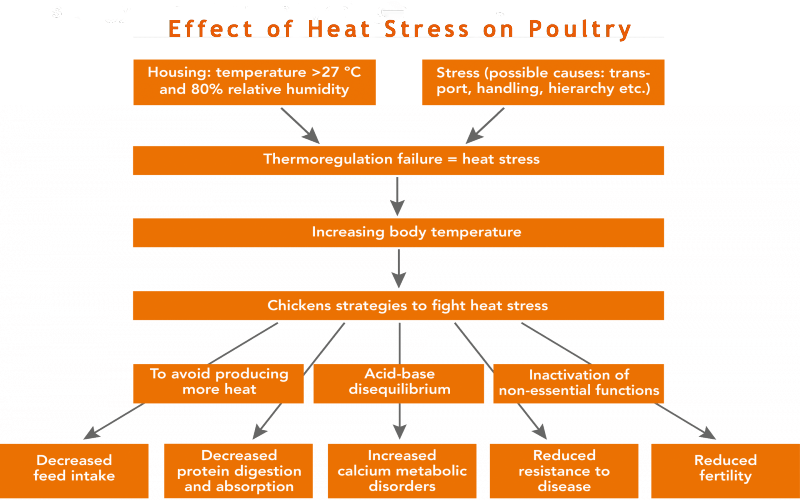
Birds become heat stressed when they have difficulty achieving a balance between body heat loss and body heat production, the average body temperature of poultry is 410 c. When the environmental temperature exceeds 350 c , a bird is likely to experience heat stress. In effect, to maintain body temperature, birds first rely on losing heat from blood vessels near the surface of the skin by a process called non-evaporative cooling. However, this mechanism is only effective when the ambient temperature is lower than the bird’s body temperature. As ambient temperature increases beyond the bird’s thermoneutral zone, non-evaporative cooling becomes ineffective. At these higher temperatures, the bird relies on panting/evaporative cooling to control body temperature. Panting is an effective but energy-expensive way for the bird to regulate body temperature. It typically results in lower feed intake and growth and reduced feed efficiency.
It will also increase water intake to offset water loss. Still, the situation is complicated because the body’s ability to retain water is reduced as the evaporative cooling process escalates. During high ambient temperatures, the birds increase panting up to 10 times from an average rate of 25 breaths/min to 250 breaths/min, which leads to an excessive loss of carbon dioxide resulting in raised blood plasma bicarbonate levels and increased blood ph. The bird attempts to correct blood ph. by excreting bicarbonates via urine. Bicarbonates are negatively charged ions coupled with positively charged ions such as potassium to be passed in the urine. However, as potassium is essential in maintaining intracellular water balance, a loss of potassium ions via urine reduces the ability to maintain this water balance. Consequently, while birds compensate for water losses associated with panting by consuming more water, their retention in the body cells is limited by simultaneous loss of electrolytes such as potassium in the urine.
Effect of Heat Stress on Poultry Health :
The most important effect of heat stress is to decrease body resistance and more susceptibility to E.Coli and CRD. In the condition of CRD & E-Coli, Respiratory Herbs should be given; it is a very effective herbal medicine for CRD & E-Coli.
Also, outbreaks of Gout may be seen in broilers and layers. In heat-stressed birds, blood flow increases to the upper respiratory tract, skin, and abdominal muscles for relieving heat. However, blood flow to the intestinal tract is decreased; thus, there is a reduction in appetite leading to lower feed intake. Concurrently water intake is increased, resulting in fluid contents in the intestinal tract. This further causes diarrhoea that results in loss of electrolytes needed to maintain acid-base balance. In this condition, Electral Energy is very much effective.
Clinical Sign and Symptom of Heat Stress in Birds :
The following clinical signs will be observed in heat-stressed birds :
- Panting/rapid respiration
- More intake of water
- Reduced appetite.
- Reduction of egg production
- Poor eggshell quality
- Less body weight gain in broilers
- Reduced feed efficiency
- Increase in body temperature
- Death
Post Mortem Lesions in Heat Stressed Bird :
- Dehydrated carcass
- Mucoid exudates in the mouth and nostrils
- Pale/cyanotic combs
- Pale breast muscles
- Congestion of liver, spleen, kidney, and lungs.
- Fluid contents in intestines.
- Rapid decomposition of the carcass
Now let us discuss the actions that the poultry farmers should take to combat heat stress in poultry :
The aim of adopting measures to combat heat stress is to keep birds alive and get production out of them to achieve targeted figures, i.e., the egg from layers and better body weight at particular age with specific FCR in broilers.
The following steps will help to combat heat stress in poultry farming in summer :
- Housing Management
- Water Management
- Feed Management
- General Management
Housing Management in Poultry Farming in Summer :
- Orient the long axis of poultry houses in an east-west direction to minimize solar heating and direct sunlight access.
- Poultry houses in the tropics should have good roof insulation (if possible with false roofs to reduce the conduction of heat) with the support of fogger and cooler systems.
- In open-sided houses, the width of a house will be a limiting factor, so keep the optimum width (24-32 ft) based on temperature, humidity and wind velocity, type of house, and birds’ nature for adequate cross ventilation.
- Increased air movement over the birds by coolers/fans/exhaust to produce a wind chill effect. It will also keep the birds cool, even without a drop in the house temperature.
- Shed design and construction should not allow direct sunlight on birds.
- Thatching of the roof with paddy straw or sugar cane leaves will reduce the temperature inside the shed.
- The roof should be painted with a whitewash to reflect light.
- Shades from tall trees and plantations around the sheds can reduce the radiant heat. The plantation of trees should be such that trees will be leafy during summer and bald during winter.
- Roof overhangs should be sufficient (3-5 ft) to protect the birds from strong sunrays.
Water Management in Poultry Farming in Summer :
Practically water is the essential criterion of these four managemental factors during summer. In summer, water consumption is 3-4 times more. Even a slight shortfall of water can lead to heatstroke and mortality. Usually feed, and water consumption ratio is 1:2, but when the temperature shoots beyond 950F, this ratio may increase to 1:4 or more. The following points are to be taken into consideration for the poultry water in summer :
- Supply of plenty of clean and cool water (60-700F) must be ensured during the summer months.
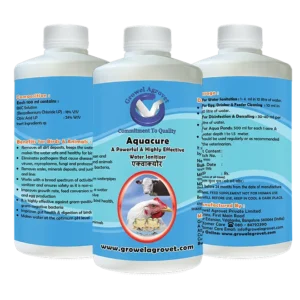
- Always use Aquacure in water to control infections through the water.
- For day-old chicks, provide cool water and electrolytes on their arrival to the farm before offering feed to avoid dehydration after transportation.
- Cover water tanks with wet gunny bags to avoid direct exposure to the sun.
- Increase the number of drinkers by 25%.
- Increase frequency of watering.
- In the case of nipple drinkers, insulate the nipple pipe with a wet gunny cloth.
- Provide Electral Energy (1-2 gm/litre) in water during hot hours.
- Adjust the amounts of medications and volumes of water used for water vaccination to reflect the flock’s increased water consumption during hot weather.
- Do not withhold drinking water from the flock when the vaccine is provided through drinking water.
Feed Management in Poultry Farming in Summer :
- During summer, the consumption of feed by birds is reduced considerably, leading to reduced body weight, egg production, and shell quality, so a proper feeding strategy is required.
- Do not offer feed during the daytime in broilers; you should feed either morning or evening.
- Specific changes in feed formulations are necessary. Increase the nutrient density of feed to compensate for depressed feed intake.
- The energy of feed should be reduced. Crude protein content should not be increased because the heat generated by one gram of fat is 16.5% or one gram of fat is 22.5%.
- Similarly, 20-30% extra vitamins and trace minerals should be added to the feed.
- The available phosphorus content of the feed should be increased.
- Vitamin C is necessary to maintain the integrity of blood vessels; supplementation of vitamin C @ 200-500 gm /ton feed will be beneficial.
- Grow E-Sel @ 200 gm /ton feed will also be beneficial.
- Pelleted feeding is beneficial where low-energy fibre diets are used.
- Since a hot, humid climate favours the growth of moulds/fungi in feed, so constant use of anti-fungal is recommended.
- The diet should be balanced with limiting amino acids, methionine, and lysine, which will give better results.
- Increase the calcium level from 3-3.5% in a layer bird’s diet.
General Management in Poultry Farming in Summer :
- Preferably fresh litter of 2 inches thickness with racking or stirring of litter 2-3 times a day during cool hours is recommended.
- 10% extra floor space should be provided in summer.
- Overcrowding of birds should be avoided.
- Farmers should do the shifting, transportation, de-beaking, and vaccination during the night or cool hours of the day.
- Birds severely heat stressed may be dipped in cold water for 2-3 minutes keeping their neck and head above water level.
- Provide proper cross ventilation. Fans (pedestal, ceiling, or exhaust) may be fitted in sheds.
- Use foggers in the shed, which could reduce the shed temperature up to 5-100c depending upon quality.
- The use of paint, white lime, etc. practically reduces the shed temperature up to 20c
- Use a side curtain in the shed, which should be sprinkled with water.
- Provide three exhaust fans on one side and pad cooling on another side, which will completely seal the shed sides and brings down the temperature below 80 c
- Use sprinklers on the top or inside the shed.
- Surround the house with tall trees & thatched roof is suitable for hot areas.
- The house should be situated away from other buildings to facilitate the free movement of air.
- The high altitude of the roof is ordinarily 2.6 to 3.3 m from the foundation to the roofline to provide maximum ventilation.
- Provide a 1-meter overhang to cut the direct sun and rain into the house
With some attention to proper management to combat heat stress, the poultry flock will remain healthy and productive throughout the summer. These simple methods will help you to maintain the bird’s health & productivity in hot weather. These guidelines will directly or indirectly make unexpected results in total poultry production.
I wish you all the best while doing poultry farming in the summer!
It would help if you also read Heat Stress in Layer Poultry
If you are into poultry related business & want to earn maximum profit in your business, please join our Facebook group How To Do Profitable Poultry & Cattle Farming?